ZayZoon Employer Portal: 2% → 13%+ Conversion
Coaching and maturing teams through fundamentals to achieve massive growth

Overview
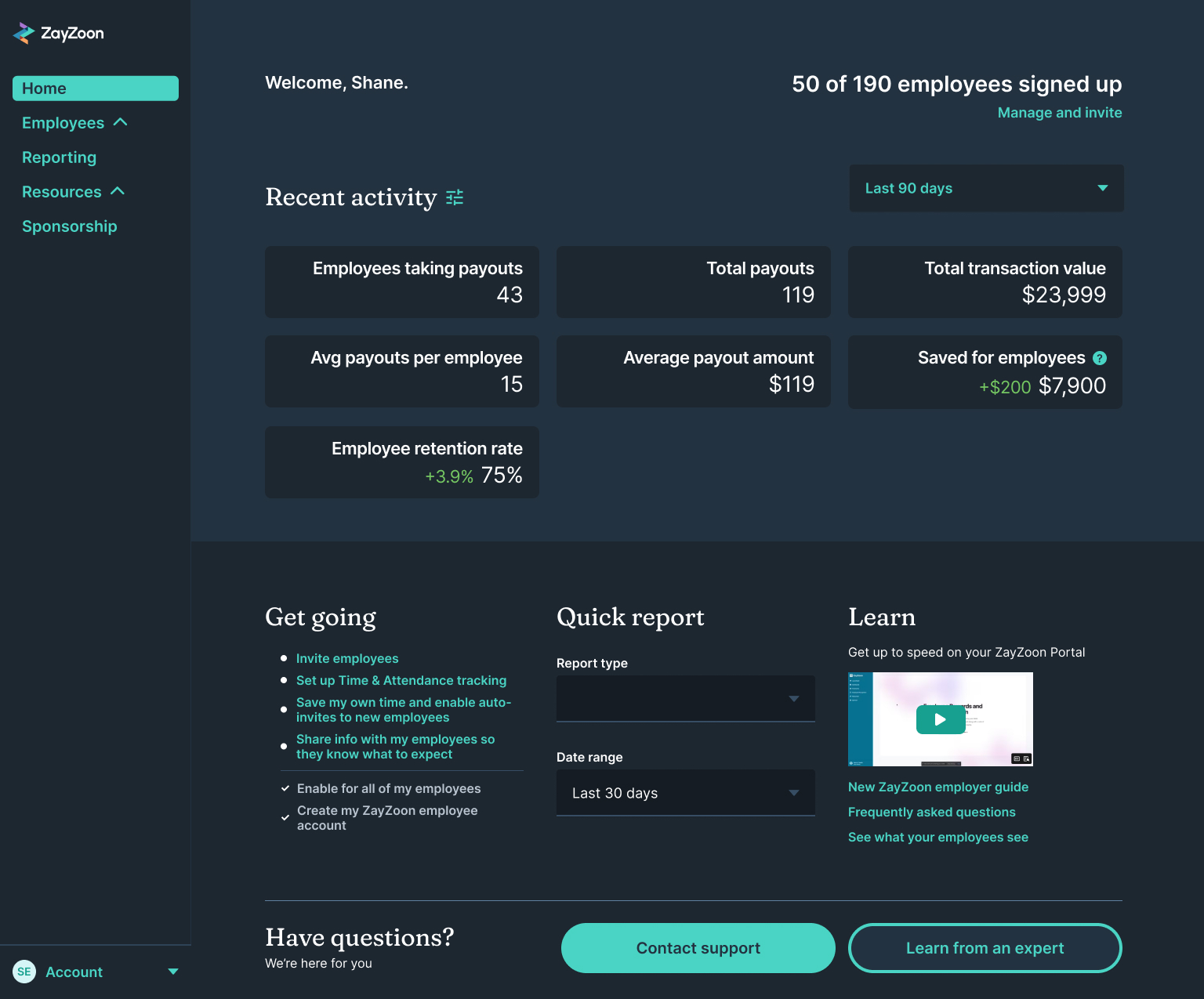
ZayZoon’s Employer Portal was a fragmented, sales‑led interface owned across Marketing, Sales, and Product, lacking a clear purpose and driving only 2% conversion for B2B SMBs. I established it as a true Product surface, integrated the Echo design system, and applied PLG principles—lifting conversion to 13% (+550% relative) while enabling the team to add another +9% (to 22%) post‑handover through sustained coaching.
Problem
Who owns the thing? Who should drive it? What are we trying to do? Uh oh.
- Ownership chaos: No single owner; teams fought over purpose (“sales tool?” “support portal?” “marketing lead page?”).
- Poor/no onboarding: Employers dumped into a bloated dashboard (~20+ low‑use pages) without value education.
- No understanding of the user journey: Most pages, like the one below, were presented with enticing messages, as if they were trying to pull the user into a product they were already in.
- UX debt: Inconsistent with the consumer app; no shared components, mobile issues.
- Sales/support bottleneck: No PLG; heavy reliance on manual coaching.
- Metrics: 2% conversion (B2B SaaS norm), high support tickets, slow iteration.

Discovery
I led research with Sales, Marketing, and Employer Support:
- User interviews: Employers were overwhelmed and confused, unclear on ZayZoon’s benefits/next steps.
- Support/lead analysis: There was a high volume of “how does this work?” type questions.
- Internal insights:
- Our consumer app (Echo, design-system-enabled) featured stronger guided flows I had recently helped implement and learned a lot from.
- Like the consumer app, employers had accessibility concerns being in highly flourescent-lit or sunlit areas, where dark mode could be a benefit.
- Team audit: Very few existing Agile rituals and otherwise low Agile maturity, siloed work, and no Product-Led Growth (PLG) knowledge.
HMWs:
- How might we define a clear product purpose and own it?
- How might we create PLG onboarding that educates + converts?
- How might we align with Echo for speed/consistency?


Strategy
1. Establish Product Ownership
I brought together the Sales, Marketing, and Product leaders and pushed for clarity. Starting with our current business outcomes, product outcomes, and an understanding of the employer segment to ground the group, I facilitated a conversation to define the desired outcomes this employer portal should drive. Folks reached an easy alignment: the goals were product-based and should be owned by the Product team going forward.
I began to unify stakeholders around PLG as the model with no more sales/support crutches, but they were leery since this was their first encounter with PLG. They would need to better understand how PLG could help them, rather than just stealing their own deals. I recruited support from another senior leader to educate teams on PLG going forward, share early discovery and other learnings with other groups, and ensure we articulated how PLG would lead to higher-quality deals for Sales by removing smaller, low-touch fish from their lead pool.
2. Foundations + Echo
- Prune to MVP.
- Stop story bloat.
- Utilize “Story mapping” techniques to teach iterative design concepts.
- Leverage our Echo design system for instant hierarchy, light/dark modes, accessibility, and mobile support, while reducing back-and-forth with the team.
3. PLG Reset
I taught the team the foundations of PLG via a couple of short education sessions, a casual book club (expensing a PLG book for everyone), and by walking them through simple exercises.
The PLG strategy I taught the team to follow was one of “progressive disclosure”: Employer awareness → education → quick wins to reach value fast → pushing from the dashboard once people are ready on to bigger interactions and program operations.
4. Team Velocity
I coached the team through Agile/Scrum rituals, component reuse, and modular design. In particular, I focused on maturing the team’s retrospectives and its desire for self-improvement, moving toward naturally seeking outcomes rather than awaiting guidance on outputs. Around this time, we hired a new PM to jump in here, so I helped get them up to speed and able to take on more of the product management tasks I had been owning.
You can see a glimpse of some of the exercises and education pieces below.


Solution
Onboarding Flow
- Landing: Clear value proposition + benefit carousel (Echo cards/buttons).
- Education: Contextual explainers (“How ZayZoon helps your team”).
- Quick Wins: Personalized setup actions (e.g., “Invite your first employee”).
- Dashboard: Pruned to 5–7 core paths; stage‑aware nav.
Echo Integration
- Tokens for consistent theming (light/dark modes).
- Shared components cut design time by ~25%.
- WCAG AA compliance by default.
Team Enablement
- Established planning and retrospectives for handover success.
- PDLC and RACI definitions.
- Workshops: PLG patterns, Echo usage, presentation kits.
Partner to Test and Drive MVP
We found a key payroll company partner in isolved to help us test a refined journey and other iterations. This also helped put a hard lens on an MVP, honing in on what isolved’s employers needed or struggled with most.


Testing & iteration
- Alpha: Internal validation of speed/consistency gains with isolved as a partner.
- Beta: 8 employer tests outside of isolved—confirmed understanding + intent uplift.
- 2 iterations: Tightened actions, personalized based on feedback, and added additional onboarding materials.
Outcomes
- Conversion:
- 2% → 13% (Month 1, +550%).
- Team added +7% (Month 2, 20%).
- Then +2% (Month 3, 22%) via coaching.
- Efficiency: Design time ~25% faster; TtM improved via Echo/rituals.
- Product: Bloat cut; now official B2B2C product surface.
- Team: Adopted PLG/systems thinking for sustained gains.
This proved PLG + systems = scalable conversion in B2B2C, shifting from a fragmented support tool to a revenue engine. The Sales team was freed to focus on larger accounts rather than smaller ones that didn’t need hand-holding.

Content for this case study is being prepared. Please check back soon.