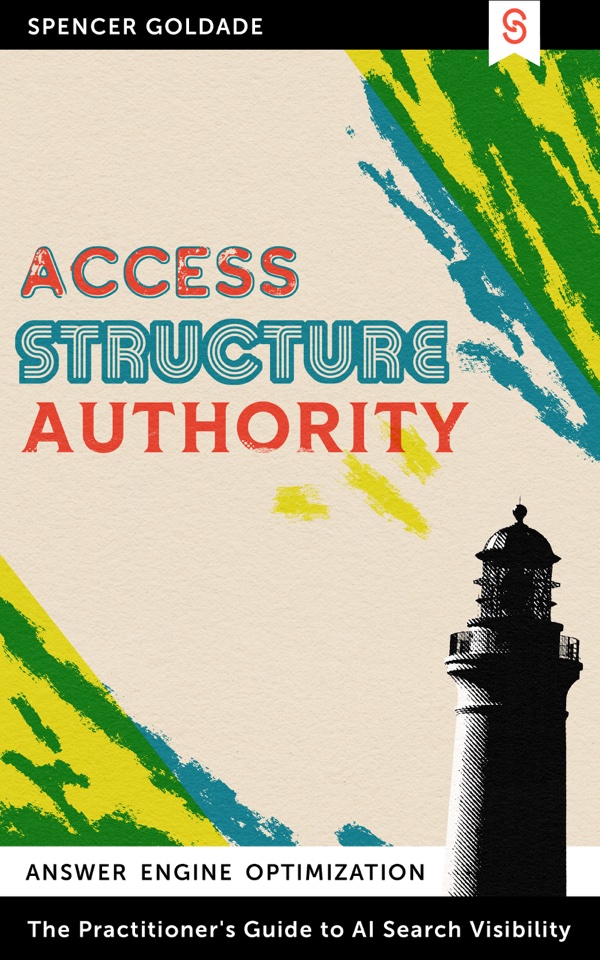
I am a product leader. My first book is about Answer Engine Optimization, the practitioner’s name for getting your content cited by ChatGPT, Perplexity, Gemini, and Google’s AI Overviews, to name a few. On paper, that might sound like I’m doing a weird pivot. While working on updates for spencergoldade.ca and monkeyslunch.com, I was digging into this when a friend commented that I often do so much research, make my own templates and tools, and so on, that I should just make a book next time I do that. And so… I did.
The pattern I kept seeing
Over the last couple of months, I audited a LOT of websites. Most were fine by traditional SEO standards. They ranked, earned clicks, and had solid content. But when I asked any questions that those sites should have answered, they did not come up. Which means someone else’s content got the citation. And I didn’t want that to happen to me while I’m pumping out products lately that I want to be noticed.
In April 2026, I ran a proper audit: 50 B2B SaaS and marketing-tool sites, scored on five AEO signals. My full methodology and the per-site data are in the book. Two findings stood out.
First, it has nothing to do with access. 96% of the sites I checked out allowed AI bots in robots.txt. This means almost everyone is letting the robot crawlers in.
Second, the gap was in structure and authority signals. For example:
- Only 38% had an llms.txt file.
- Only 62% had an Organization schema on their homepage.
- The average score across all 50 sites was 3.04 out of 5.
- Two sites scored a perfect 5. 28% scored 4 or higher.
The kicker there is that the sites I was auditing were marketing and SEO tool vendors, which is to say, businesses you would expect to be further along on this than average. Naughty! If this is the optimistic case with companies that know what they’re doing, then the median site in a less self-aware category almost certainly scores worse.
The old SEO playbook does not explain this gap, because the gap is not about backlinks or keywords. It is about whether your content is structured so that an AI system can extract a clean answer and attribute it to you without ambiguity. That is a discoverability and usability problem. And THAT is why a product person ended up writing about it.
Why product thinking applies
Product folks are constantly creating things to solve end-user problems. AI is another kind of user. Arguably, a much easier one to design for. Because AI follows specific access patterns:
- It times out quickly.
- It does not execute JavaScript unless a bot specifically supports it.
- It reads schema markup, not just rendered text.
- It needs clear entity signals to decide which
Asana
or whichSpencer Goldade
you are before it will cite you.
The product discipline already knows how to think about users like that. We look at things like someone’s access pattern, work backward from the task the user is trying to complete, and make the system legible to them. I kept running into sites that were well-designed for humans and accidentally hostile to AI. Not because anyone meant to block AI, but because no one had yet considered AI a user with its own requirements.
The book is organized around a three-layer diagnostic I call Access, Structure, Authority, which aims to help you answer the following:
- Can AI reach your content?
- Can it extract a clean answer from it?
- Does your brand carry enough authority that AI is willing to stake its credibility on citing you?
When AI is not citing you, the gap is almost always in the lowest unresolved layer, and working up from there beats fixing the symptom on top. That is how the book is organized, and it is how I audit a site in real life.
What the book is, and who it is for
This book is a practitioner’s guide. Six appendices carry the reference material: robots.txt and llms.txt templates, a schema library, a full audit checklist, a glossary, a tools reference.
The audience is SEO practitioners, content strategists, product marketers, founders addicted to AI, and agency owners who already know what robots.txt is and how Google ranks pages, and now need to know what is different for AI search. This is not a beginner’s SEO guide, though, and it does not try to convince you that AI search is a big deal. If you are reading this, you likely already know how much it matters to you.
A few rules I held myself to:
- Every claim is sourced: if a number comes from Ahrefs or Similarweb or Conductor, the attribution is in the text; if it comes from my own audit, the raw data is available for verification.
- Uncertainty is labelled ESTABLISHED, EMERGING, or SPECULATIVE, so you can tell what is settled and what is still a hypothesis.
- And AI assistance I used myself is disclosed in the front matter of the book, because Chapter 9 argues for disclosure, and a book making that argument should apply it to itself.
I also ran my own rubric against my two sites. spencergoldade.ca scored 5/5 after an afternoon of implementing what the book recommends. On the flip side, monkeyslunch.com scored 3/5, deliberately: that site blocks training bots in certain capacity because I don’t want bots learning from my creative writing, art, or games. Therefore, the framework is a diagnostic, not a universal prescription. Like me, you don’t have to adhere to AIO if you don’t want to. Where I made trade-offs on my own sites, I show the reasoning.
How to get it
The book and the supporting files live at spencergoldade.ca/aeo. Three products on that page, purchased via Gumroad:
- The ebook (an epub) on its own is CAD $9.99.
- The AEO Tools and Template Files, CAD $39, is the part I think will actually sit open on your second monitor. Seven schema templates, three robots.txt configurations, a prompt bank, trackers, checklists, the canonical-facts template, the hub-and-spoke worksheet, the quarterly refresh template, a platform decision tree, the raw research data, and the 90-day action plan in four formats.
- The ebook + tools bundle is CAD $44, which saves CAD $4.99 if you want both.
If you would rather try two of the bundle files before buying, the hub-and-spoke content-mapping worksheet and the 90-day action plan are free at spencergoldade.ca/aeo-samples. No form, no gate.
If something in it changes how you run a site, I would like to hear about it.